Sendera
Sendera
Independent UX/UI case study
From problem framing to interface design, informed by research.
Mobile app for group traveling
Quick Overview
Context and framing
Planning a trip together
Planning a trip with others means juggling chats, documents, and decisions across multiple apps. In this process information gets lost, duplicated, or misunderstood gradually becoming a source of friction.
Early on, it became clear that the problem wasn’t a lack of tools. It was the absence of a shared source of truth. A single place everyone could trust and return to. Sendera is built around that idea.
Context and framing
Planning a trip together
Planning a trip with others means juggling chats, documents, and decisions across multiple apps. In this process information gets lost, duplicated, or misunderstood gradually becoming a source of friction.
Early on, it became clear that the problem wasn’t a lack of tools. It was the absence of a shared source of truth. A single place everyone could trust and return to. Sendera is built around that idea.
What the research revealed
Insights and synthesis
Research snapshot
Qualitative exploration of group travel planning
5 in-depth interviews with travelers who seek group experiences (friends or on-site tours).
Focused on real planning behaviors, not ideal scenarios.
Research emphasized ownership, decision-making, and accountability as recurring tensions.
Goal: To understand why group travel planning breaks down before designing a solution.
Quick look at:


Traveler profiles
Key pain points
What the research revealed
Insights and synthesis
Research snapshot
Qualitative exploration of group travel planning
5 in-depth interviews with travelers who seek group experiences (friends or on-site tours).
Focused on real planning behaviors, not ideal scenarios.
Research emphasized ownership, decision-making, and accountability as recurring tensions.
Goal: To understand why group travel planning breaks down before designing a solution.
Quick look at:
What the research revealed
Insights and synthesis
Research snapshot
Qualitative exploration of group travel planning
5 in-depth interviews with travelers who seek group experiences (friends or on-site tours).
Focused on real planning behaviors, not ideal scenarios.
Research emphasized ownership, decision-making, and accountability as recurring tensions.
Goal: To understand why group travel planning breaks down before designing a solution.
Quick look at:
Traveler profiles
Key pain points
The core problem
When planning becomes a burden
Group travel planning breaks down when decisions, money, and tasks have no clear owner.
How might we design a single shared space where groups can plan together without losing information, money, or trust?
Principles: Make information visible to everyone · Make money transparent · Reduce choices to enable decisions
The core problem
When planning becomes a burden
Group travel planning breaks down when decisions, money, and tasks have no clear owner.
How might we design a single shared space where groups can plan together without losing information, money, or trust?
Principles: Make information visible to everyone · Make money transparent · Reduce choices to enable decisions
How Sendera works
Core features & flows
Step-by-step trip builder
Users plan trips through a guided flow that breaks decisions into smaller steps (destination, dates, activities), reducing cognitive load during planning.
Centralized itinerary view
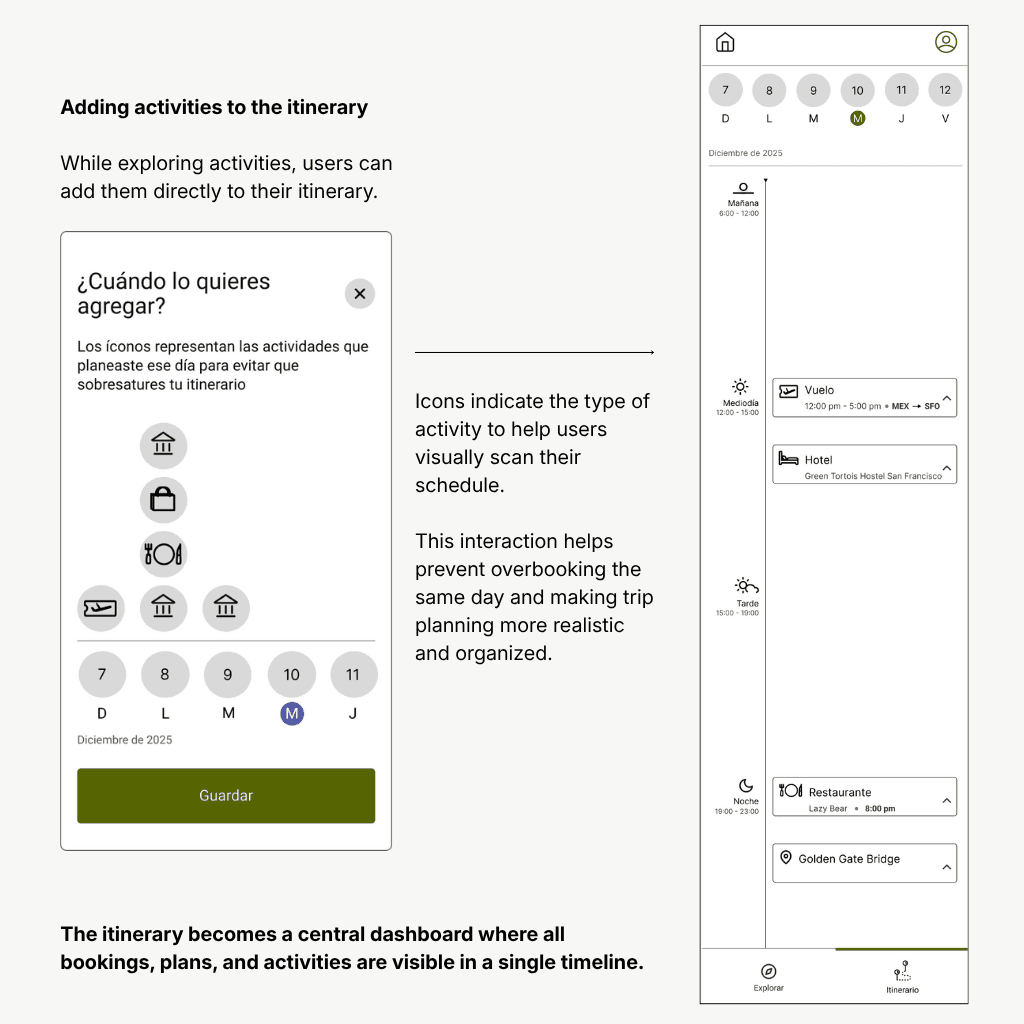
All bookings, activities, and notes are organized in a single itinerary timeline, allowing travelers to quickly understand their plan at a glance.
Shared expense tracking
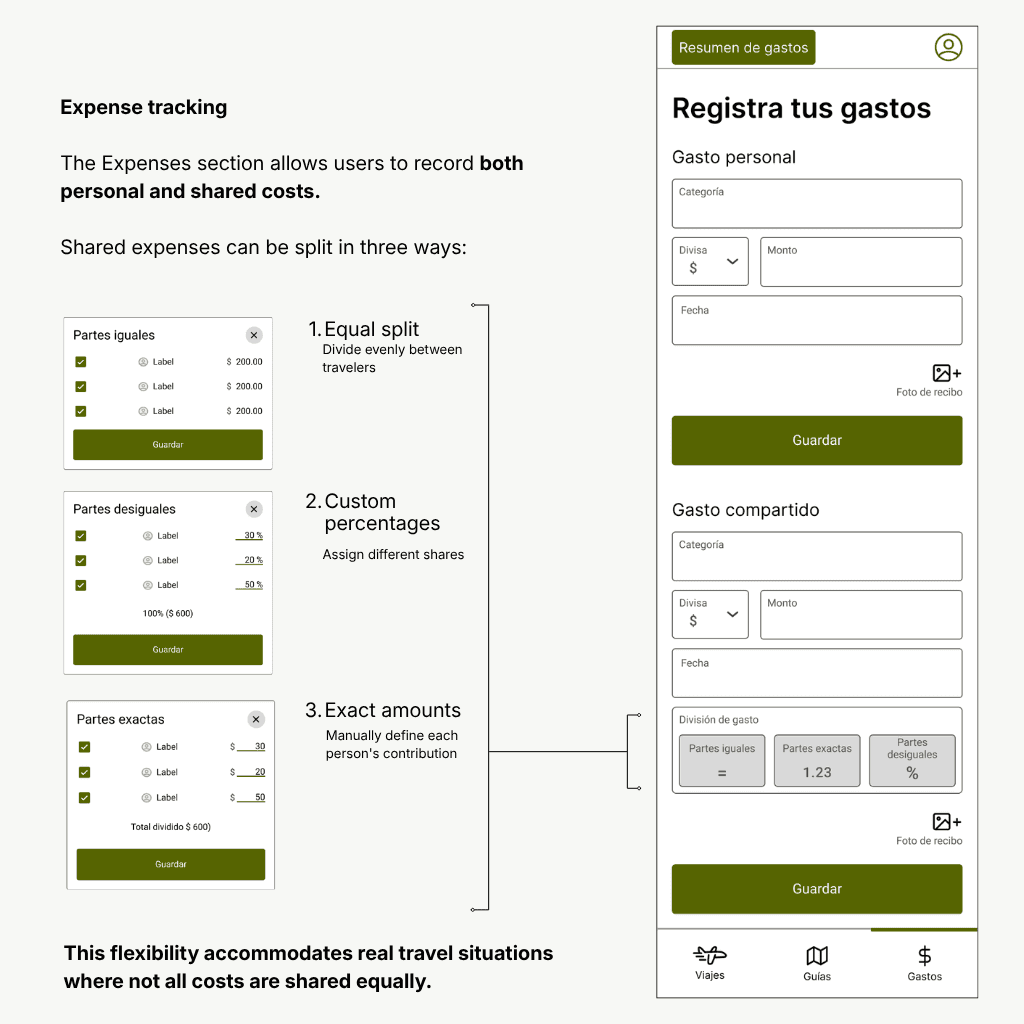
Users can log and split trip expenses within the app, creating a transparent record of who paid for what. By centralizing shared costs, the feature reduces friction and misunderstandings that often occur during group travel.
Product Architecture
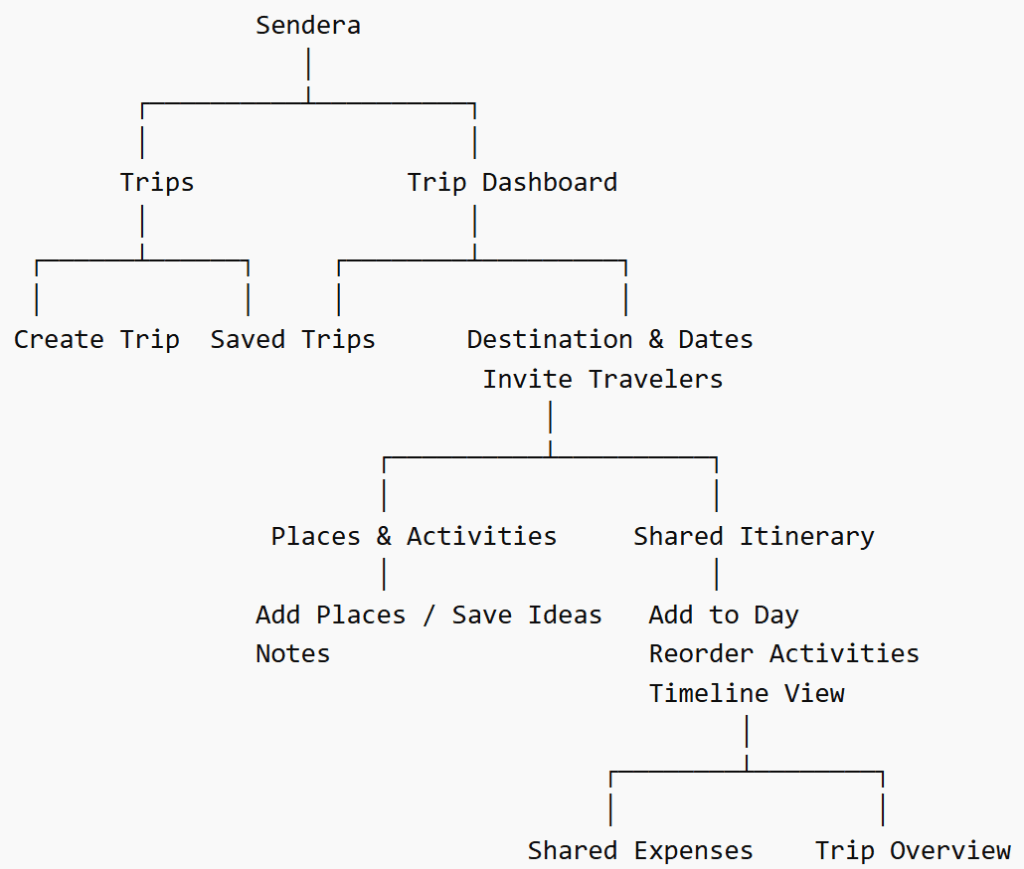
Sendera is structured around a collaborative trip system where travelers create trips, invite collaborators, and organize destinations, activities, and shared expenses into a centralized itinerary.
How Sendera works
Core features & flows
Step-by-step trip builder
Users plan trips through a guided flow that breaks decisions into smaller steps (destination, dates, activities), reducing cognitive load during planning.
Centralized itinerary view
All bookings, activities, and notes are organized in a single itinerary timeline, allowing travelers to quickly understand their plan at a glance.
Shared expense tracking
Users can log and split trip expenses within the app, creating a transparent record of who paid for what. By centralizing shared costs, the feature reduces friction and misunderstandings that often occur during group travel.
Product Architecture
Sendera is structured around a collaborative trip system where travelers create trips, invite collaborators, and organize destinations, activities, and shared expenses into a centralized itinerary.
From structure to interface
UI design
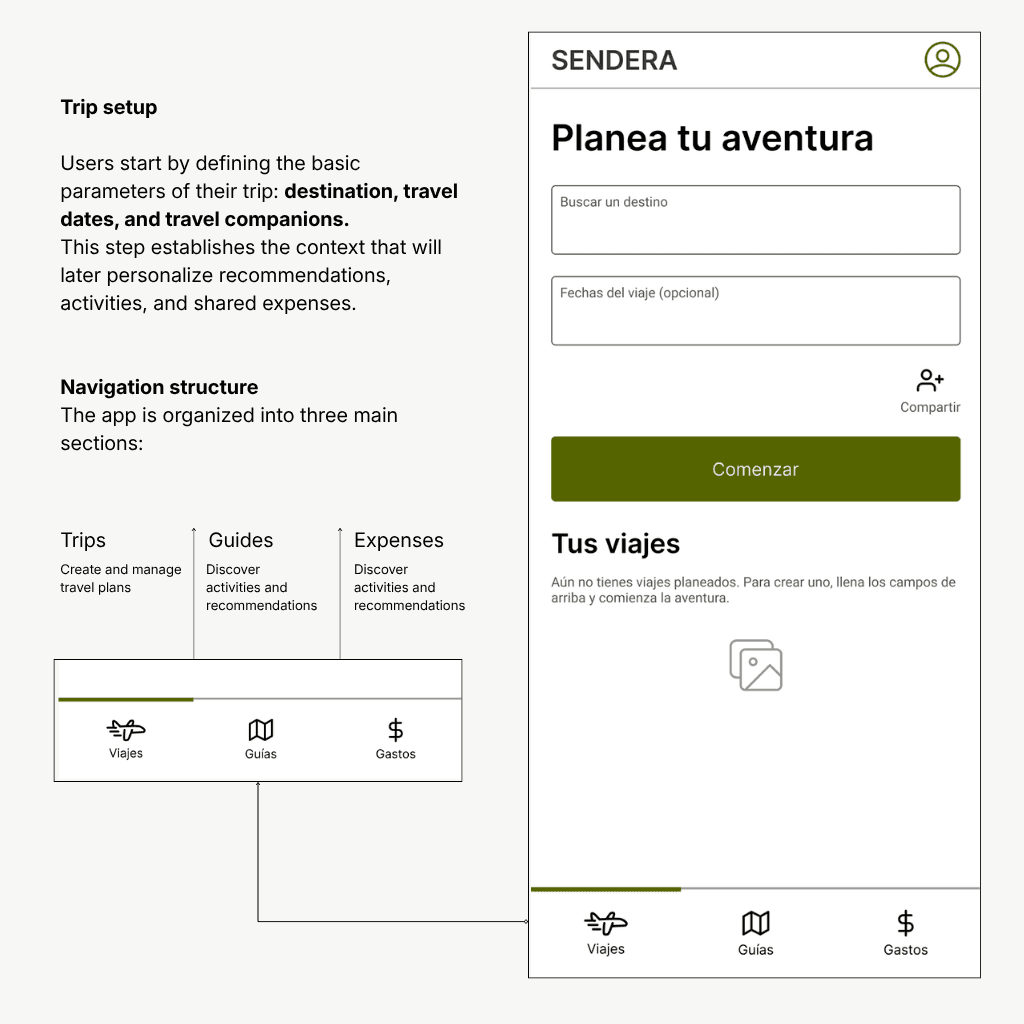
During early wireframing, I focused on simplifying how users create and organize a shared trip.
Research on travel planning behavior suggested that people typically begin with destination and dates, then gradually add activities and places. The flow I designed breaks the process into smaller steps: destination → exploration → scheduling.
Key features:
Trip set up- Define destination, travel dates and companions
Curated activity discovery- Explore recommended places and experiences
Smart itinerary planning- Add activities to a timeline without overbooking.
Flexible expense splitting- Split costs evenly, by percentage, or exact amount.
From structure to interface
UI design
During early wireframing, I focused on simplifying how users create and organize a shared trip.
Research on travel planning behavior suggested that people typically begin with destination and dates, then gradually add activities and places. The flow I designed breaks the process into smaller steps: destination → exploration → scheduling.
Key features:
Trip set up- Define destination, travel dates and companions
Curated activity discovery- Explore recommended places and experiences
Smart itinerary planning- Add activities to a timeline without overbooking.
Flexible expense splitting- Split costs evenly, by percentage, or exact amount.
Usability testing
Moderated usability study · UseBerry · Remote
10 participants
7 tasks tested
3m 1.1s average session time
40% full study completion rate.
The 40% full completion rate reflects the study's intentional design: participant profiles were matched to specific tasks, meaning not all participants went through every scenario. Drop-off was by design, not by failure
Task results
Task | Description | Completed | Time on task |
|---|---|---|---|
1 | Create a new trip | 5/5 | 13.6s |
2 | Discover what to visit | 5/5 | 43.4s |
3 | Explore and add activities to the itinerary | 5/5 | 41.1s |
4 | Register and split a shared expense | 4/5 | 41.5s |
5 | Check the overall trip status. | 3/4 | 24.0s |
Usability testing
Moderated usability study · UseBerry · Remote
10 participants
7 tasks tested
3m 1.1s average session time
40% full study completion rate.
The 40% full completion rate reflects the study's intentional design: participant profiles were matched to specific tasks, meaning not all participants went through every scenario. Drop-off was by design, not by failure
Task results
Task | Description | Completed | Time on task |
|---|---|---|---|
1 | Create a new trip | 5/5 | 13.6s |
2 | Discover what to visit | 5/5 | 43.4s |
3 | Explore and add activities to the itinerary | 5/5 | 41.1s |
4 | Register and split a shared expense | 4/5 | 41.5s |
5 | Check the overall trip status. | 3/4 | 24.0s |
Methodology detail
What broke and why it mattered
Findings
Horizontal carousels weren't perceived as scrollable
Design decision
Reduced card width so adjacent cards are partially visible, making the swipeable pattern immediately legible.

Date carousel didn't read as interactive
Design decision
Adjusted the clip so the circle is clearly cut making the overflow intentional and the interaction obvious.

Expense screen was too overwhelming
Design decision
Expense categories were turned into collapsible cards, while the summary button was moved to the fixed bottom nav for constant visibility.

What broke and why it mattered
Findings
Horizontal carousels weren't perceived as scrollable
Design decision
Reduced card width so adjacent cards are partially visible, making the swipeable pattern immediately legible.
Date carousel didn't read as interactive
Design decision
Adjusted the clip so the circle is clearly cut making the overflow intentional and the interaction obvious.
Expense screen was too overwhelming
Design decision
Expense categories were turned into collapsible cards, while the summary button was moved to the fixed bottom nav for constant visibility.
Horizontal carousels weren't perceived as scrollable
During the session, none of the participants swiped the destination carousel horizontally. The card edges weren't visible enough to signal that more content existed beyond the frame.
Design decision
Reduced card width so adjacent cards are partially visible, making the swipeable pattern immediately legible.
Date carousel didn't read as interactive
The date selector used a circular element that got clipped at the screen edge. Participants didn't recognize it as something they could scroll.
Design decision
Adjusted the clip so the circle is clearly cut making the overflow intentional and the interaction obvious.
Expense screen was too overwhelming
The cluttered expense screen caused users to overlook the summary button, as all categories and fields were visible at once.
Design decision
Both expense categories were redesigned as collapsible cards, reducing visual noise and letting users focus on what's relevant.
The expense summary button was moved to the bottom navigation bar and highlighted in green, making it visible regardless of scroll position.
Reflection
Sendera started as a question about tools and ended as a question about trust, how do you make a group feel like they're working from the same page?
Testing confirmed that task completion isn't the same as confidence. Users could finish a flow and still feel uncertain. That gap is where the most interesting design problems live.
Limits: One round of testing with 10 individual participants. Group dynamics between real travel companions remain untested, the next step would be a session with an actual group planning a real trip.